Human role
The user declares the task, provides inputs, reviews evidence, resolves important ambiguity, approves the final output and decides what action is permitted.
A portable operating architecture designed to be understandable, repeatable and reviewable across supported AI environments.
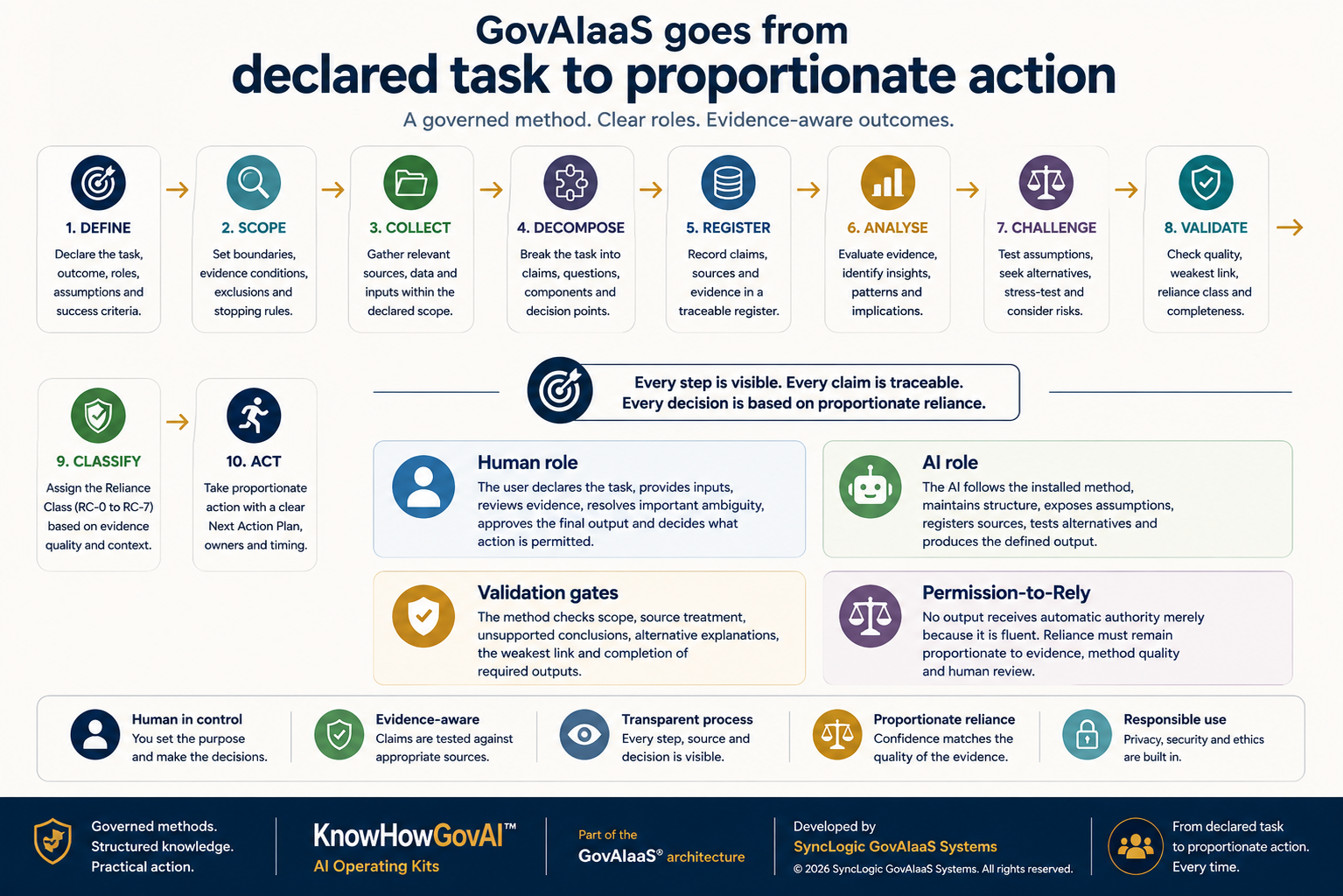
The ten-stage workflow moves through Define, Scope, Collect, Decompose, Register, Analyse, Challenge, Validate, Classify and Act. Claims, sources and evidence are recorded so that important elements remain traceable.
The human declares the task, supplies inputs, reviews evidence, resolves ambiguity, approves the output and decides what action is permitted. The AI follows the installed method, maintains structure, exposes assumptions, registers sources, tests alternatives and produces the defined output. Validation gates check scope, source treatment, unsupported conclusions, alternatives, weakest links and completeness. No fluent output receives automatic authority: reliance remains proportionate to evidence, method quality, context and human review.
The user declares the task, provides inputs, reviews evidence, resolves important ambiguity, approves the final output and decides what action is permitted.
The AI follows the installed method, maintains the structure, exposes assumptions, registers sources, tests alternatives and produces the defined output.
The method checks scope, source treatment, unsupported conclusions, alternative explanations, the weakest link and completion of required outputs.
No output receives automatic authority merely because it is fluent. Reliance must remain proportionate to evidence, method quality and human review.